
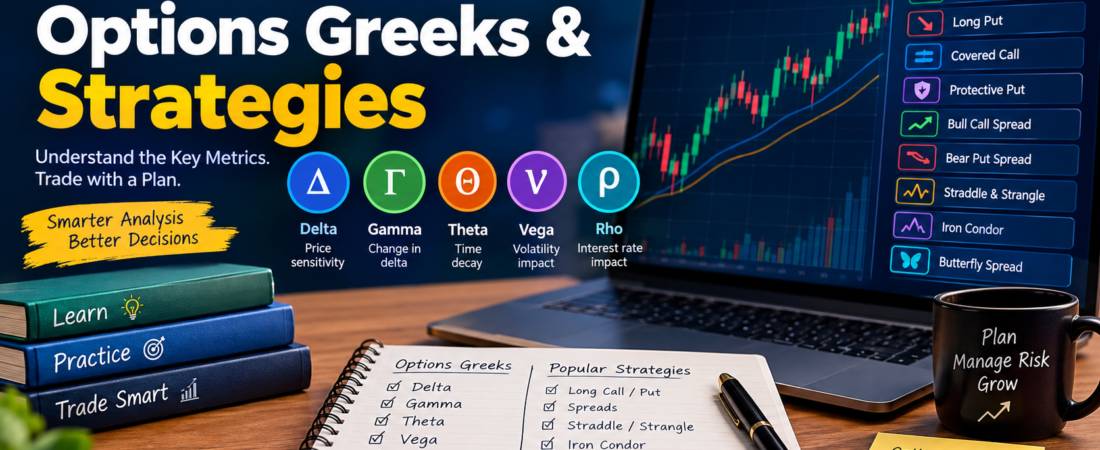
Options trading can look complicated when you first come across terms like Delta, Gamma, Theta, Vega, Straddle, Strangle, and Spreads. But once you understand what these concepts actually mean, options become much easier to analyze.
The Options Greeks help traders understand how an option’s price may react to changes in the market. Options strategies, on the other hand, combine one or more options to create a specific trading setup based on a trader’s market view.
In this guide, we will understand the major Options Greeks and some commonly used options strategies in simple language.
Important: Options trading involves significant risk. The examples in this article are for educational purposes and should not be considered financial advice.
What Are Options Greeks?
Options Greeks are measurements used to understand how different factors can affect the price of an options contract.
The five commonly discussed Greeks are:
- Delta
- Gamma
- Theta
- Vega
- Rho
Each Greek tells you something different about an option.
1. Delta
Delta measures how much the price of an option may change when the underlying asset moves by one unit, all else being equal.
For example, suppose a call option has a Delta of 0.50.
If the underlying stock increases by ₹10, the option price could theoretically increase by around ₹5, assuming other factors remain unchanged.
Typical Delta ranges
For call options:
- ITM calls generally have positive Delta.
- ATM calls often have Delta around 0.50.
- OTM calls have lower positive Delta.
For put options:
- Put Delta is generally negative.
- ATM puts are often around -0.50.
Delta is also sometimes used as a rough indication of how sensitive an option is to the underlying price.
2. Gamma
Gamma measures how quickly an option’s Delta changes when the underlying asset moves.
In simple words:
Delta tells you the current sensitivity, while Gamma tells you how that sensitivity can change.
Gamma is generally highest for options that are close to the strike price, particularly around expiration.
For option buyers, higher Gamma can mean that Delta changes quickly when the underlying makes a significant move.
3. Theta
Theta represents the effect of the passage of time on an option’s value.
Options have a limited lifespan. As expiration gets closer, the time available for the expected move becomes smaller.
This is known as time decay.
For option buyers, Theta is generally a disadvantage because the option can lose value as time passes if other factors remain unchanged.
For option sellers, time decay can work in their favor, although selling options comes with potentially substantial risks.
Simple example
Imagine an option is worth ₹100 today.
If the underlying price and other variables remain unchanged, the option may lose some of its time value as expiration approaches.
That loss is related to Theta.
4. Vega
Vega measures an option’s sensitivity to changes in implied volatility (IV).
If implied volatility increases, option premiums generally become more expensive, all else being equal.
If implied volatility falls, option premiums generally become cheaper.
This is particularly important around events such as:
- Earnings announcements
- Major economic data
- Central-bank decisions
- Elections
- Important company announcements
A trader can therefore be correct about the direction of the market but still experience an unexpected change in the option premium because volatility changes.
5. Rho
Rho measures an option’s sensitivity to changes in interest rates.
For short-term options, Rho is usually less important than Delta, Gamma, Theta, and Vega.
However, it can become more relevant when dealing with longer-dated options.
Why Are Options Greeks Important?
Options Greeks can help traders answer questions such as:
- How sensitive is my option to price movement?
- How quickly could the option’s Delta change?
- How much value could disappear because of time decay?
- What happens if volatility increases or decreases?
- How could interest-rate changes affect the option?
Instead of looking only at whether the market will go up or down, Greeks encourage traders to consider how the option itself may behave.
Understanding Implied Volatility
Implied Volatility (IV) is an important concept in options trading.
It reflects the market’s expectations about potential future price movement and is derived from option prices.
Higher IV generally means higher option premiums, while lower IV generally means lower premiums, assuming other factors remain unchanged.
However, high IV does not automatically mean that the market will move up or down. It mainly indicates that the options market is pricing in greater potential movement.
What Are Options Strategies?
An options strategy is a predefined combination of buying or selling options based on a particular market expectation.
A trader may choose a strategy depending on whether they expect:
- A strong upward move
- A strong downward move
- A limited move
- High volatility
- Low volatility
- A specific price range
Let’s look at some common strategies.
1. Long Call
A Long Call involves buying a call option.
It is generally used when a trader expects the underlying asset to rise.
Example
Suppose a trader buys a call option for a premium of ₹50.
If the underlying asset rises significantly, the call could gain value.
The maximum loss for the buyer is generally the premium paid, while the potential upside can be substantial.
However, the underlying must move sufficiently before expiration for the trade to become profitable after considering the premium paid.
2. Long Put
A Long Put involves buying a put option.
It is generally used when a trader expects the underlying asset to decline.
The buyer pays a premium for the put.
If the underlying falls significantly, the put may increase in value.
The maximum loss for the buyer is generally the premium paid.
3. Covered Call
A Covered Call generally involves owning the underlying asset while selling a call option against it.
It is commonly used by investors who are willing to potentially sell their underlying holdings at the option’s strike price in exchange for receiving the option premium.
The premium provides income, but the strategy can limit upside participation if the underlying rises substantially.
4. Protective Put
A Protective Put involves owning the underlying asset and buying a put option.
The put can act as a form of downside protection.
For example, an investor holding shares may buy a put to establish a minimum exit price for the position, subject to the terms of the option.
The cost of this protection is the premium paid for the put.
5. Bull Call Spread
A Bull Call Spread uses two call options with different strike prices.
Typically, a trader:
- Buys a lower-strike call.
- Sells a higher-strike call.
The strategy is generally used when the trader expects a moderately bullish move.
The sold call helps reduce the initial cost, but it also limits the maximum profit.
6. Bear Put Spread
A Bear Put Spread uses two put options with different strike prices.
Typically:
- Buy a higher-strike put.
- Sell a lower-strike put.
It is generally used when a trader expects a moderately bearish move.
Like the Bull Call Spread, the strategy has defined characteristics for both potential profit and loss.
7. Long Straddle
A Long Straddle involves:
- Buying a call
- Buying a put
- Using the same strike price and expiration
The strategy is generally used when a trader expects a large price movement but is uncertain about its direction.
The trader can potentially benefit from a strong move either upward or downward.
However, if the underlying remains relatively stable, both options can lose value because of time decay.
8. Long Strangle
A Long Strangle is similar to a straddle, but the call and put usually have different strike prices.
Typically:
- Buy an OTM call.
- Buy an OTM put.
Because the options are further away from the current price, the initial cost can be lower than a comparable straddle.
However, the underlying generally needs to make a larger move for the strategy to become profitable.
9. Iron Condor
An Iron Condor combines four options and is commonly used when a trader expects the underlying to remain within a particular range.
It generally consists of:
- Selling an OTM put
- Buying a further OTM put
- Selling an OTM call
- Buying a further OTM call
The strategy has defined maximum profit and maximum loss when structured as a standard iron condor.
It is often associated with range-bound market expectations.
10. Butterfly Spread
A Butterfly Spread is a multi-leg options strategy designed around a specific price range or target area.
A standard long call butterfly typically uses three strike prices.
It can be useful when a trader expects the underlying to remain close to a particular price by expiration.
The strategy generally has limited risk and limited potential profit.
Options Buying vs Options Selling
One of the biggest differences in options trading is whether you are buying or selling options.
Options Buying
Advantages can include:
- Defined maximum loss for a straightforward long option
- Potential for significant returns from large moves
- No requirement to maintain unlimited-risk exposure
Challenges include:
- Time decay
- Volatility changes
- The underlying may need to move quickly enough
- An option can lose value even if the trader’s general direction is correct
Options Selling
Potential characteristics include:
- Time decay can work in favor of the seller
- Premium is received upfront
- Multiple factors can affect profitability
However, selling options can involve substantial losses, depending on the strategy. Some forms of uncovered option selling can have very large or theoretically unlimited risk.
Understanding margin requirements and risk is therefore essential.
How Greeks and Strategies Work Together
Greeks become especially useful when evaluating an options strategy.
For example:
Long Call
- Positive Delta
- Positive Gamma
- Negative Theta
- Positive Vega
Long Put
- Negative Delta
- Positive Gamma
- Negative Theta
- Positive Vega
Option-selling strategies
Depending on the structure, they may generally have:
- Negative Gamma
- Positive Theta
- Negative Vega
The exact Greek exposure depends on the specific strikes, expiration, position size, and market conditions.
A Simple Way to Analyze an Options Trade
Before entering an options trade, consider these questions:
1. What is my market view?
Do I expect:
- Upward movement?
- Downward movement?
- A range?
- A large move in either direction?
2. How much time is available?
Check the option’s expiration date.
3. What is the implied volatility?
A large change in IV can significantly affect option premiums.
4. What are the Greeks?
Look at:
- Delta
- Gamma
- Theta
- Vega
- Rho
5. What is my maximum potential loss?
Know this before entering the trade.
6. What is my exit plan?
Decide beforehand when you will:
- Take profit
- Cut the loss
- Adjust the position
- Exit before expiration
Common Mistakes Beginners Make
1. Buying Cheap OTM Options
A low premium does not automatically mean an option is a good opportunity.
The underlying may never move enough before expiration.
2. Ignoring Theta
Holding a short-dated option while waiting for a move can be expensive because time decay can work against the buyer.
3. Ignoring IV
Option premiums can change because of volatility even when the underlying price has not moved much.
4. Trading Without a Risk Plan
Options can move quickly, especially around major events.
Always understand the maximum potential loss of the strategy.
5. Using Too Many Strategies at Once
Beginners often try to learn every strategy immediately.
It is usually more useful to understand a small number of strategies properly before moving to more complicated structures.
Final Thoughts
Options Greeks and strategies are two sides of the same subject.
Greeks help explain how an option can react to changes in price, time, volatility, and interest rates. Strategies provide a structured way to express a particular market view.
You do not need to memorize every options strategy at once. Start with the basics: Delta, Gamma, Theta, Vega, and Rho, then learn simple strategies such as Long Call, Long Put, Bull Call Spread, Bear Put Spread, Straddle, and Strangle.
Most importantly, understand the risk before entering a trade. In options trading, knowing the potential loss is just as important as knowing the potential profit.
Learn first. Practice with paper trading. Then consider real-money trading only after you understand the strategy and its risks.
Frequently Asked Questions
What are Options Greeks?
Options Greeks are measures that help traders understand how an option’s price may respond to factors such as the underlying asset price, time, volatility, and interest rates.
Which Greeks are most important for beginners?
Delta, Gamma, Theta, and Vega are commonly useful starting points. Rho becomes more relevant in certain longer-duration options.
What is Delta in options?
Delta measures the approximate sensitivity of an option’s price to a change in the underlying asset, all else being equal.
What is Theta?
Theta measures the effect of the passage of time on an option’s value. For option buyers, time decay is generally a disadvantage.
What is Vega?
Vega measures an option’s sensitivity to changes in implied volatility.
What is a Straddle?
A long straddle involves buying a call and a put with the same strike price and expiration. It is generally used when a trader expects a large move but is uncertain about the direction.
Is options trading risky?
Yes. Options can involve substantial risk, and some strategies can expose traders to losses beyond the initial premium paid. Traders should understand the payoff and risk characteristics of a strategy before using it.