
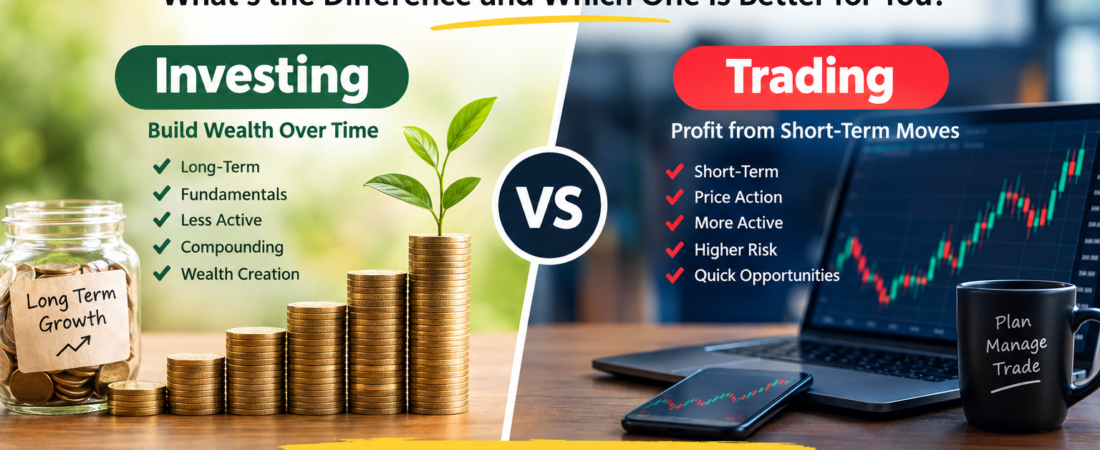
When people start learning about the stock market, two words come up again and again: investing and trading.
At first, they may seem like the same thing. Both involve buying and selling financial assets with the goal of making money. But the way investors and traders approach the market is very different.
Investing is generally focused on building wealth over a longer period of time, while trading focuses more on taking advantage of shorter-term price movements.
So, which one is better?
The answer depends on your goals, time, risk tolerance, knowledge, and how actively you want to manage your money.
In this article, we’ll explain the difference between investing and trading in simple terms so you can understand which approach may suit you better.
What Is Investing?
Investing means buying an asset with the intention of holding it for a longer period of time.
For example, an investor might buy shares of a company because they believe the business can grow over the next five, ten, or even twenty years.
Instead of worrying about every daily price movement, investors usually focus on things such as:
- Company growth
- Revenue and profits
- Business quality
- Industry trends
- Management
- Valuation
- Dividends
- Long-term economic conditions
The basic idea is simple: buy quality assets and give them time to grow.
Example of Investing
Suppose you invest ₹50,000 in a diversified portfolio of stocks.
If the companies perform well over the next several years, the value of your investment may increase. You may also receive dividends from some companies.
You don’t necessarily need to buy and sell every day.
This is one reason investing can be suitable for people who have limited time to follow the market.
What Is Trading?
Trading is more focused on shorter-term price movements.
A trader attempts to buy an asset at a favorable price and sell it later at a higher price, or potentially profit from a decline through strategies that allow short selling.
Depending on the trading style, positions may be held for:
- A few minutes
- Several hours
- A few days
- Several weeks
Traders often use tools such as:
- Price charts
- Technical indicators
- Support and resistance
- Market structure
- Volume
- Price action
- Risk management
The main goal is generally to identify a potential trading opportunity and manage the risk associated with that trade.
Example of Trading
Imagine a trader sees a stock trading at ₹500.
Based on their analysis, they believe the price could move toward ₹520 in the short term.
They enter a trade and plan their stop-loss and target before entering.
If the expected move happens, they may make a profit. If the market moves against them, the stop-loss can limit the potential loss.
Unlike investing, trading requires more active decision-making.
Investing vs Trading: Key Differences
The biggest difference between investing and trading is time horizon and approach.
| Investing | Trading |
|---|---|
| Usually long-term | Usually short-term |
| Focuses on business and fundamentals | Often focuses on price movements |
| Lower day-to-day activity | Requires more active monitoring |
| Usually fewer transactions | Can involve frequent transactions |
| Patience is important | Discipline and timing are important |
| Long-term wealth creation is a common goal | Short-term opportunities are a common goal |
| Compounding can play a major role | Risk management is extremely important |
Neither approach is automatically better for everyone.
Which Is Riskier: Investing or Trading?
Both investing and trading involve risk.
However, the type and level of risk can be very different.
Long-term investing can still lose money, especially when someone invests in individual companies without proper research or buys assets at unrealistic valuations.
Trading can carry significant risk because short-term price movements can happen quickly.
Some traders also use leverage, which can increase both potential gains and potential losses.
This is why risk management is important regardless of whether you invest or trade.
Never assume that trading guarantees quick profits.
Investing vs Trading: Which Requires More Time?
Trading generally requires more time and attention.
A trader may need to:
- Study the market.
- Find potential setups.
- Decide where to enter.
- Set a stop-loss.
- Set a potential target.
- Monitor the position.
- Review the trade afterward.
An investor may spend more time researching an asset before buying and then periodically reviewing the investment.
If you have a full-time job or don’t want to watch charts regularly, long-term investing may be easier to manage.
Can You Be Both an Investor and a Trader?
Yes.
You don’t necessarily have to choose only one.
Some people maintain a long-term investment portfolio while also trading a smaller portion of their capital.
For example, someone might keep most of their money in long-term investments and use a separate, smaller amount for trading.
The important thing is to understand the difference between the two approaches and manage each one according to its own risk rules.
What Is Better for Beginners?
For many beginners, understanding long-term investing first can be a good starting point.
Why?
Because beginners often make the mistake of believing that the stock market is a place to make quick money.
In reality, successful market participation requires knowledge, patience and discipline.
If you’re interested in trading, start by learning the basics before putting significant money at risk.
Learn about:
- Risk management
- Position sizing
- Stop-losses
- Trading psychology
- Technical analysis
- Market volatility
- Trading costs
Most importantly, don’t risk money you cannot afford to lose.
Investing or Trading: How to Choose?
Ask yourself a few simple questions.
1. What is my financial goal?
If your goal is building wealth over many years, investing may be more appropriate.
If you’re interested in actively participating in short-term market opportunities, trading may interest you more.
2. How much time can I give?
If you cannot regularly monitor the market, active trading may be difficult.
3. How comfortable am I with risk?
Both investing and trading involve risk. You should understand how much potential loss you can realistically handle.
4. Do I enjoy analyzing businesses or charts?
Investors may spend more time studying businesses and financial information.
Traders often spend more time studying price charts and market behavior.
5. Can I control my emotions?
This is important for both.
Fear, greed and impatience can lead to poor financial decisions.
Common Mistakes Beginners Should Avoid
Whether you’re investing or trading, some mistakes are surprisingly common.
Chasing quick profits
The expectation of making money quickly can lead to unnecessary risk.
Investing without research
Buying a stock simply because someone recommended it online isn’t a proper investment strategy.
Trading without a plan
Entering a trade without knowing where you will exit if you’re wrong can result in unnecessary losses.
Using too much leverage
Leverage can magnify losses as well as profits.
Ignoring risk management
Protecting your capital is more important than trying to win every trade.
Following social media blindly
Financial content on social media can be useful for learning, but not every prediction or strategy is reliable.
Always do your own research.
The Bottom Line
Investing and trading are two different approaches to participating in financial markets.
Investing is generally about patience, long-term growth and building wealth over time.
Trading is generally about taking advantage of shorter-term market movements while carefully managing risk.
There is no universal answer to which one is better.
The right choice depends on your financial goals, available time, knowledge, risk tolerance and personality.
If you’re just starting, focus first on learning how financial markets work. Don’t rush into making money.
A good financial journey is not about getting rich overnight. It’s about making informed decisions, managing risk and improving your knowledge over time.
Disclaimer: This article is for educational and informational purposes only. It is not financial, investment or trading advice. Financial markets involve risk, and you should conduct your own research or consult a qualified financial professional before making investment decisions.