
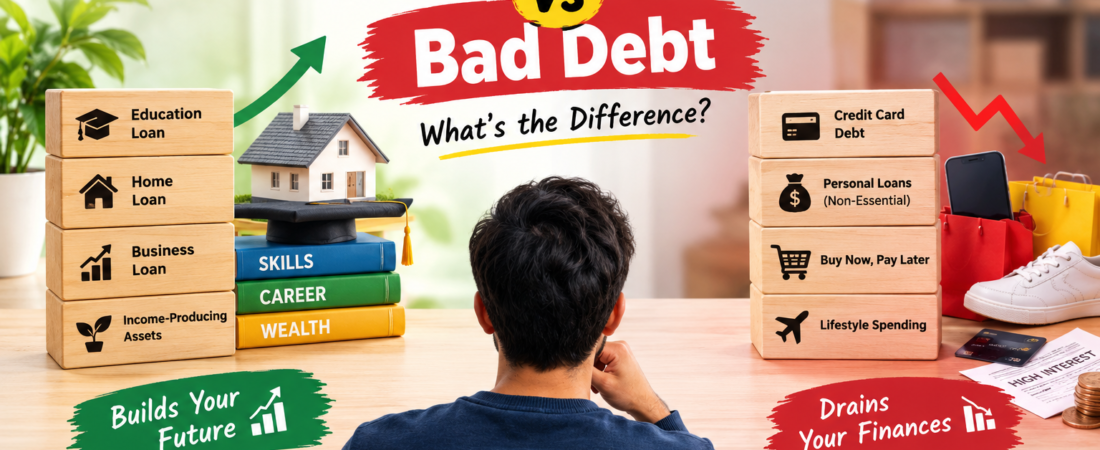
Debt is a normal part of life for many people. Whether it is a home loan, education loan, credit card balance, or personal loan, borrowing money can sometimes help us achieve important goals.
But not all debt works the same way.
Some debt can help you build wealth, improve your financial situation, or invest in something valuable. Other debt can become expensive and difficult to manage, especially when it is used for unnecessary spending.
This is where the idea of good debt vs bad debt comes in.
Understanding the difference can help you make smarter borrowing decisions and avoid financial problems in the future.
What Is Good Debt?
Good debt is generally debt that can help improve your financial position over time.
It is usually connected to something that may increase in value, increase your earning potential, or provide a useful long-term benefit.
However, even debt that is considered “good” needs to be handled carefully. Interest rates, repayment terms, and your ability to make the payments all matter.
Examples of Good Debt
1. Education Loan
An education loan can be useful when it helps you gain a degree, professional qualification, or skill that improves your future earning opportunities.
For example, borrowing money to complete a course that significantly improves your career prospects may provide a long-term benefit.
But it is important to consider the total cost of the education and the expected income after graduation before taking a large loan.
2. Home Loan
A home loan can sometimes be considered good debt because it allows you to purchase a property without paying the entire cost upfront.
A property may also become more valuable over time, although property values are never guaranteed to increase.
A home loan can still become a financial burden if the monthly payment is too high compared with your income.
3. Business Loan
Borrowing money to start or expand a business can be productive debt when the money is used carefully.
For example, a business owner might use a loan to purchase equipment, increase production, or expand into a new market.
The important question is whether the business can generate enough income to comfortably repay the loan.
4. Debt for Income-Producing Assets
Some borrowing can be used to purchase assets that generate income.
For example, a loan might be used to purchase equipment for a small business or another productive asset.
The key is to understand the numbers before borrowing rather than assuming that every investment will generate a profit.
What Is Bad Debt?
Bad debt is generally borrowing that provides little or no long-term financial benefit and can become expensive because of high interest rates.
It is often associated with buying things that lose value quickly or spending more than you can comfortably afford.
Examples of Bad Debt
1. High-Interest Credit Card Debt
Credit cards can be convenient, but carrying a balance for a long time can become expensive because of interest and other charges.
If you regularly spend more than you can repay, credit card debt can grow quickly.
Using a credit card is not automatically bad. The problem usually starts when the balance continues to roll over and becomes difficult to repay.
2. Personal Loans for Unnecessary Purchases
A personal loan can be useful for certain needs, but borrowing money for things you don’t really need can create unnecessary financial pressure.
For example, taking a loan for expensive gadgets, luxury purchases, or entertainment may leave you paying for those purchases long after you have stopped using them.
3. Buy Now, Pay Later Debt
Buy Now, Pay Later services can make expensive purchases feel affordable because the cost is divided into smaller payments.
The danger is that several small payments can add up.
If you use multiple payment plans at the same time, it can become difficult to keep track of your total monthly obligations.
4. Borrowing for Lifestyle Spending
Borrowing money to maintain a lifestyle that is above your actual income can create a cycle of debt.
For example, constantly borrowing to pay for expensive vacations, shopping, restaurants, or entertainment can make it harder to build savings.
Good Debt vs Bad Debt: Simple Comparison
| Good Debt | Bad Debt |
|---|---|
| May improve your financial position | Often reduces your financial flexibility |
| Can support education or career growth | Often used for unnecessary spending |
| May help purchase productive assets | Often used for rapidly depreciating items |
| Can potentially generate future income | Usually does not generate income |
| Usually has a clear financial purpose | Often comes from impulse purchases |
| Should still be carefully managed | Can become expensive quickly |
Remember that this is a general guideline. The same type of loan can be useful for one person and harmful for another depending on the interest rate, repayment ability, purpose, and overall financial situation.
Is All Debt Bad?
No.
Debt itself is not necessarily good or bad.
What matters is why you are borrowing, how much you are borrowing, how much interest you will pay, and whether you can comfortably repay it.
For example, taking a reasonable home loan that fits your income is very different from using high-interest debt to pay for unnecessary purchases.
Instead of asking only:
“Is this good debt or bad debt?”
Ask yourself:
- Why do I need to borrow this money?
- How much interest will I pay?
- Can I comfortably afford the monthly payment?
- Will this borrowing help me financially in the future?
- What happens if my income decreases?
- Do I already have other debts?
These questions can give you a much clearer picture.
How to Avoid Bad Debt
You don’t need to avoid every form of borrowing. The goal is to borrow responsibly.
1. Create a Budget
Before taking a loan, look at your monthly income and expenses.
A simple budget can show you how much money is actually available for loan repayments.
2. Understand the Interest Rate
Don’t focus only on the monthly EMI.
A loan with a small monthly payment may still cost you a lot over several years.
Look at the total amount you will repay.
3. Avoid Unnecessary Borrowing
Before using a loan or credit card, ask yourself whether the purchase is actually necessary.
Waiting and saving money first can sometimes be better than borrowing.
4. Build an Emergency Fund
An emergency fund can help you handle unexpected expenses without immediately turning to credit cards or personal loans.
Even a small emergency fund can provide some financial breathing room.
5. Keep Track of Multiple Loans
Having several loans or payment plans can make your finances complicated.
Keep a record of your outstanding balances, interest rates, monthly payments, and due dates.
Can Good Debt Become Bad Debt?
Yes.
This is an important point that many people overlook.
A loan that starts as a useful financial decision can become a problem if your circumstances change.
For example, a home loan may become difficult to manage after a major reduction in income.
Similarly, a business loan may become a burden if the business does not generate the expected revenue.
That’s why you should review your debt regularly instead of assuming that a loan will always remain affordable.
Final Thoughts
The difference between good debt and bad debt is not always black and white.
Good debt generally has a clear purpose and may help improve your financial position over time. Bad debt is often connected to unnecessary spending, high interest costs, or borrowing beyond your ability to repay.
Before taking on any debt, look beyond the monthly payment. Consider the total cost, interest rate, purpose of the loan, and how the repayment will affect your monthly budget.
Debt should be a financial tool—not something that controls your finances.
The better you understand how borrowing works, the easier it becomes to make informed financial decisions and work toward your long-term money goals.