
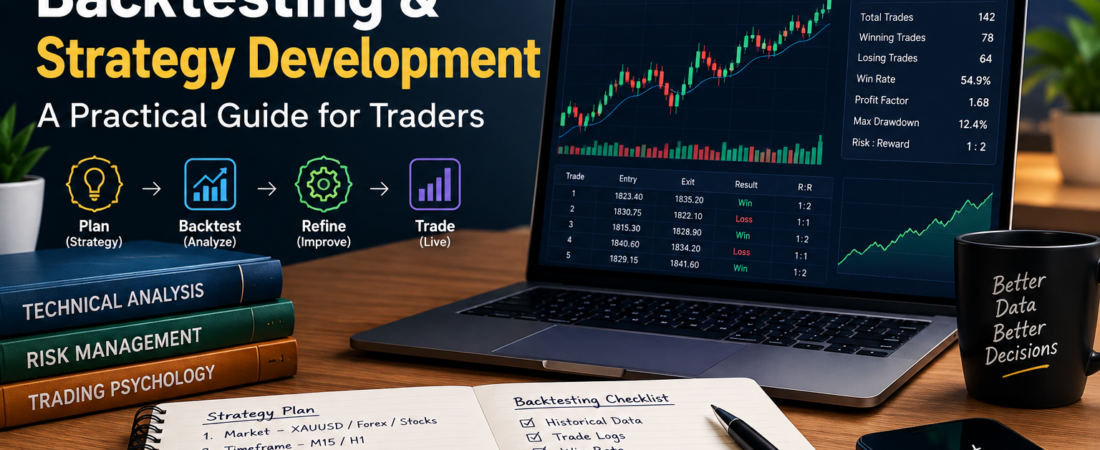
Trading can look simple when you see a chart moving up and down. But becoming consistent in trading requires more than finding a good entry point. A trader needs a well-defined strategy, proper risk management, and enough testing to understand how that strategy performs under different market conditions.
This is where backtesting and strategy development become important.
Backtesting allows traders to test a trading strategy using historical market data before applying it to live markets. Strategy development, on the other hand, is the process of creating, improving, and evaluating the rules that determine when to enter, exit, and manage a trade.
Together, they can help traders replace random decision-making with a structured approach.
What Is Backtesting?
Backtesting is the process of applying a trading strategy to historical price data to see how it would have performed in the past.
For example, suppose you create a strategy that says:
- Buy when the price moves above the 50 EMA.
- Confirm the trend with another indicator.
- Place a stop-loss below the recent swing low.
- Target a 1:2 risk-to-reward ratio.
Instead of immediately risking real money, you can test these rules against historical charts.
The results can show things such as:
- Number of trades
- Winning trades
- Losing trades
- Win rate
- Average profit and loss
- Maximum drawdown
- Profit factor
- Risk-to-reward performance
However, past performance does not guarantee future results. Markets change, and a strategy that performed well historically may behave differently in live trading.
Why Is Backtesting Important?
One of the biggest mistakes new traders make is changing strategies after a few losing trades.
A trader might use one strategy today, another tomorrow, and a completely different setup next week. This makes it difficult to know whether the strategy actually works.
Backtesting provides a more structured way to evaluate an idea.
Instead of asking:
“Does this strategy look good?”
You can ask:
“How did this strategy perform across a specific historical period under clearly defined rules?”
That difference is important.
Backtesting can also help traders identify weaknesses before they risk significant capital.
What Is Strategy Development?
Strategy development is more than adding indicators to a chart.
A complete trading strategy should clearly define what you are looking for and what you will do when the conditions appear.
A basic strategy-development process can include:
1. Define the Market
First decide what you want to trade.
For example:
- Stocks
- Forex
- Gold
- Indices
- Futures
- Cryptocurrencies
Different markets have different characteristics, so a strategy should be tested on the market for which it was designed.
2. Choose the Timeframe
Your timeframe affects the number of trading opportunities and the amount of market noise.
For example:
- 1-minute and 5-minute charts are commonly used for short-term trading.
- 15-minute and 1-hour charts can be used for intraday setups.
- Daily and weekly charts are often used for longer-term analysis.
There is no single timeframe that works for every trader.
3. Create Clear Entry Rules
Your entry conditions should be specific enough that two people can look at the same chart and reach the same conclusion.
For example:
Buy conditions:
- Price is above the 50 EMA.
- A bullish breakout occurs.
- The candle closes above the breakout level.
- Risk is within the predefined limit.
The goal is to avoid vague rules such as “buy when the market looks strong.”
4. Define Stop-Loss Rules
Every strategy should explain where a trade becomes invalid.
A stop-loss could be based on:
- Recent swing high or low
- Volatility
- ATR
- A fixed percentage
- A specific technical level
The method should be consistent with the strategy.
5. Define the Exit
You also need clear rules for taking profit or closing a trade.
Common approaches include:
- Fixed risk-to-reward ratio
- Previous support or resistance
- Trailing stop
- Moving-average exit
- Market-structure-based exit
A strategy without a clear exit plan can easily become an emotional decision.
Manual vs Automated Backtesting
There are two common approaches to backtesting.
Manual Backtesting
Manual backtesting involves going through historical charts and recording trades based on your strategy rules.
For example, you can move through a chart candle by candle and record:
| Trade | Entry | Stop Loss | Target | Result |
|---|---|---|---|---|
| 1 | $100 | $98 | $104 | Win |
| 2 | $105 | $103 | $109 | Loss |
| 3 | $102 | $100 | $106 | Win |
Manual testing takes time, but it can help traders understand how their strategy behaves visually.
Automated Backtesting
Automated backtesting uses software or code to apply predefined rules to historical data.
This can allow hundreds or thousands of historical trades to be tested much faster.
Trading platforms and programming environments can be used to build automated tests, depending on the market and platform.
However, automation does not automatically make a strategy better. If the rules are poorly designed, a computer can simply test a poor strategy faster.
Important Backtesting Metrics
Looking only at profit is not enough.
Several metrics can provide a better picture of strategy performance.
Win Rate
Win rate shows the percentage of trades that were profitable.
For example, if a strategy wins 55 trades out of 100:
Win Rate = 55%
But a high win rate does not necessarily mean a strategy is profitable.
A strategy could win many small trades while occasionally suffering very large losses.
Risk-to-Reward Ratio
Risk-to-reward compares the amount you are willing to lose with the potential profit.
For example, risking $100 to potentially make $200 gives a:
1:2 risk-to-reward ratio
The relationship between win rate and average win/loss is therefore important.
Maximum Drawdown
Maximum drawdown measures the largest decline from a previous peak in the strategy’s account value during the tested period.
For example, if an account grows from $10,000 to $15,000 and later falls to $12,000 before recovering, the drawdown from that peak is $3,000, or 20%.
Drawdown is important because a strategy can be profitable overall while still experiencing difficult losing periods.
Profit Factor
Profit factor compares total gross profits with total gross losses.
A simplified formula is:
Profit Factor = Gross Profit ÷ Gross Loss
It can help you understand how much gross profit was generated relative to gross losses.
Avoid Overfitting
One of the biggest dangers in strategy development is overfitting.
Overfitting happens when a strategy is adjusted too heavily to historical data until it performs extremely well on that specific dataset.
For example, a trader might keep changing:
- Indicator settings
- Entry conditions
- Stop-loss distance
- Take-profit levels
- Trading hours
until the historical results look excellent.
The problem is that the strategy may have learned the historical data rather than identifying a robust market behavior.
A strategy should not be judged only by how perfectly it fits the past.
Test Different Market Conditions
Markets do not behave the same way all the time.
There can be:
- Strong trends
- Sideways markets
- High-volatility periods
- Low-volatility periods
- Major news events
- Rapid reversals
A strategy that performs well during strong trends may struggle in a sideways market.
Therefore, testing across different market conditions can provide more useful information than testing during only one favorable period.
Use Out-of-Sample Testing
A useful approach is to separate historical data into different sections.
For example:
Data A → Strategy development
Data B → Out-of-sample testing
The strategy is developed using one portion of historical data and then tested on data it was not optimized on.
This can help reveal whether the strategy has reasonable robustness outside the data used to create it.
Include Trading Costs
A backtest can look profitable on paper but produce different results in live trading.
Why?
Because real trading can involve:
- Spread
- Commission
- Slippage
- Swap or overnight charges
- Execution delays
These costs should be considered whenever possible.
This is especially important for high-frequency or short-term strategies, where trading costs can represent a significant portion of the expected profit.
Keep a Trading Journal
Backtesting becomes much more useful when you keep organized records.
For every trade, consider recording:
- Date
- Market
- Timeframe
- Entry
- Stop-loss
- Take-profit
- Setup
- Risk
- Result
- Market condition
- Notes
Over time, this data can reveal patterns that are difficult to notice from individual trades.
From Backtesting to Live Trading
A positive backtest does not mean you should immediately start trading large amounts of real money.
A more controlled process can be:
Idea → Strategy Rules → Backtesting → Refinement → Out-of-Sample Testing → Demo/Simulation → Small Live Testing → Ongoing Review
Each stage provides additional information.
The goal is not to find a strategy that never loses. No realistic trading strategy can guarantee that.
The goal is to understand the strategy’s behavior and determine whether its potential return and risk are acceptable for your trading plan.
Common Backtesting Mistakes
1. Changing Rules During the Test
If you change the rules every time you encounter a losing trade, the results can become misleading.
2. Ignoring Losing Periods
A strategy should be evaluated using its complete test results, not only its best trades.
3. Using Too Few Trades
A handful of successful trades does not provide enough evidence to understand a strategy’s behavior.
4. Ignoring Costs
Spread, commissions, and slippage can materially affect results.
5. Over-Optimizing
Adding too many conditions can make a strategy complicated and fragile.
6. Assuming Past Results Will Repeat
Historical results are useful for analysis, but they cannot guarantee future performance.
Final Thoughts
Backtesting and strategy development are valuable parts of a disciplined trading process.
Instead of entering trades based purely on emotions, predictions, or random signals, traders can create clear rules and examine how those rules behaved historically.
A good strategy-development process focuses on clarity, consistency, risk management, testing, and continuous review.
The purpose of backtesting is not to prove that a strategy will make money in the future. Its purpose is to understand the strategy better, identify weaknesses, and determine whether the idea has enough evidence to justify further testing.
Trading always involves risk. A well-tested strategy can improve the quality of your decision-making, but it cannot remove market uncertainty.
Frequently Asked Questions
What is backtesting in trading?
Backtesting is the process of testing a trading strategy against historical market data to evaluate how it would have performed under specific rules.
Is backtesting enough to guarantee a profitable strategy?
No. Backtesting can provide useful historical evidence, but it cannot guarantee future profits.
How many trades should I backtest?
There is no universal number that works for every strategy. More relevant and varied historical trades generally provide more information than a very small sample.
Can beginners do backtesting?
Yes. Beginners can start with simple strategies and manually test historical charts before moving toward more advanced automated testing.
What is overfitting in trading?
Overfitting occurs when a strategy is excessively optimized for historical data and may fail to perform similarly on new or unseen market data.
Should I include trading costs in a backtest?
Yes. When possible, include realistic spreads, commissions, slippage, and other applicable trading costs because they can affect real-world performance.
What is the difference between backtesting and forward testing?
Backtesting evaluates a strategy using historical data, while forward testing evaluates it on new market data, often through a demo or simulated environment before committing significant real capital.