
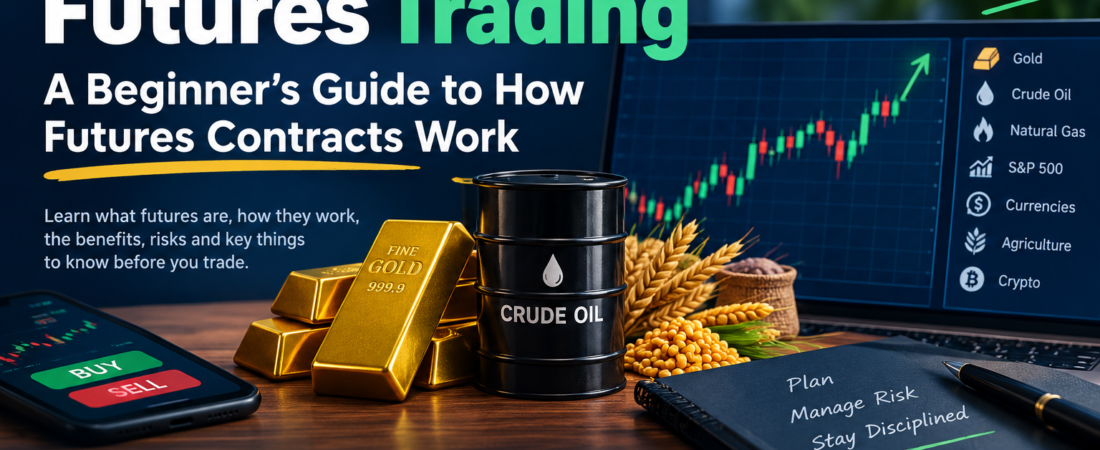
Futures trading is one of the most popular areas of financial markets. You may have heard traders talk about Bitcoin futures, gold futures, crude oil futures, stock index futures, or currency futures.
But what exactly are futures?
In simple terms, a futures contract is an agreement to buy or sell an asset at a predetermined price at a future date. Today, futures are widely used not only by professional traders but also by investors, businesses, and institutions for managing risk and gaining market exposure.
However, futures trading can also involve significant risk because of leverage. Understanding how futures work is important before considering trading them.
What Are Futures?
A futures contract is a standardized agreement between buyers and sellers.
The contract specifies important details such as:
- What asset is being traded
- The quantity of the asset
- The contract price
- The expiration date
- How the contract will be settled
For example, suppose a gold futures contract is trading at $2,500 per unit. A trader who expects the price of gold to rise may buy the futures contract. If the price increases, the trader may potentially profit by closing the position at a higher price.
On the other hand, a trader expecting the price to fall may sell a futures contract first and potentially buy it back later at a lower price.
This is one reason futures markets allow traders to take both long and short positions.
How Does Futures Trading Work?
Futures trading generally involves four basic steps.
1. Choose a Futures Market
First, a trader chooses a market or instrument.
Examples include:
- Gold
- Crude oil
- Natural gas
- Stock indexes
- Currencies
- Agricultural commodities
- Cryptocurrencies, where supported
Different futures contracts have different specifications and risks.
2. Open a Position
A trader can either:
Go Long: Buy a futures contract because they expect the price to rise.
Go Short: Sell a futures contract because they expect the price to fall.
Unlike traditional investing, traders do not necessarily need to own the underlying asset to take a position in a futures contract.
3. Monitor the Position
Once a position is open, the trader monitors price movements, margin requirements, market conditions, and their trading plan.
Futures positions can move quickly, particularly in volatile markets.
4. Close or Settle the Contract
Most individual traders close their futures positions before expiration rather than taking delivery of the underlying asset.
Depending on the contract, settlement may be handled through physical delivery or cash settlement.
What Is Leverage in Futures?
Leverage is one of the most important concepts in futures trading.
A trader usually does not need to provide the full value of the underlying position. Instead, they provide a certain amount of money known as margin.
For example, imagine a futures position has a notional value of $50,000, while the required margin is $5,000.
The trader controls a position worth $50,000 using $5,000 of margin.
This creates leverage.
Leverage can make both gains and losses larger relative to the amount of capital deposited. A relatively small market movement can therefore have a significant effect on a trader’s account.
That is why leverage should be treated as a risk-management issue, not simply as a way to increase potential profits.
What Is Futures Margin?
Margin in futures trading is not exactly the same as a traditional down payment.
It is generally money that a trader must maintain with their broker or clearing arrangement to support an open futures position.
Two common terms are:
Initial Margin
The amount required to open a futures position.
Maintenance Margin
The minimum amount of account equity that must generally be maintained while the position remains open.
If losses reduce the account below the required level, the trader may need to add funds or reduce/close the position.
Long vs Short Futures Positions
One of the attractive features of futures markets is the ability to trade in both directions.
Long Position
A trader buys a futures contract expecting the price to increase.
Example:
Gold futures price: $2,500
The trader buys at $2,500.
If the price later rises to $2,550, the position may generate a gain based on the contract’s specifications.
Short Position
A trader sells a futures contract expecting the price to decrease.
Example:
Gold futures price: $2,500
The trader sells at $2,500.
If the price later falls to $2,450, the trader may potentially profit from the decline.
The actual profit or loss depends on the contract size and price movement.
Why Do People Trade Futures?
People use futures markets for several different reasons.
1. Speculation
Some traders use futures to speculate on short-term or medium-term price movements.
They may analyze:
- Price action
- Market structure
- Economic data
- Volume
- Technical indicators
- Supply and demand
- Market sentiment
2. Hedging
Businesses and investors can use futures to manage exposure to price changes.
For example, a company that depends heavily on a commodity may use futures contracts as part of a strategy to reduce the impact of unfavorable price movements.
3. Portfolio Exposure
Futures can provide exposure to markets such as stock indexes, commodities, and currencies without directly purchasing the underlying asset.
Advantages of Futures Trading
Futures markets have several characteristics that attract traders.
High Liquidity in Major Markets
Major futures contracts can have substantial trading activity, making it easier to enter and exit positions during liquid market hours.
Ability to Trade Both Directions
Traders can potentially take long or short positions.
Leverage
Futures require margin rather than the full notional value of the contract.
However, leverage is a double-edged sword and can increase losses just as quickly as gains.
Diverse Markets
Futures are available across many asset classes, including commodities, indexes, currencies, and other financial products.
Risks of Futures Trading
Futures trading is not suitable for everyone. Understanding the risks is essential.
1. Leverage Risk
Because futures are leveraged instruments, losses can grow quickly when the market moves against a position.
2. Volatility
Some futures markets can experience rapid price movements, particularly around major economic announcements or unexpected events.
3. Margin Risk
If an account falls below required margin levels, a trader may be required to provide additional funds or close positions.
4. Overtrading
The ability to trade frequently can encourage traders to take too many positions.
More trades do not automatically mean more profits.
5. Emotional Decisions
Fear, greed, revenge trading, and the desire to recover losses quickly can lead to poor decisions.
A clear trading plan and disciplined risk management can help reduce these problems.
Futures vs Stocks
Futures and stocks are different financial instruments.
| Feature | Futures | Stocks |
|---|---|---|
| Contract-based | Yes | No |
| Leverage | Common | Usually lower |
| Long/Short | Both possible | Shorting depends on market and broker rules |
| Expiration | Many contracts expire | Stocks generally do not expire |
| Margin | Common | Depends on account type |
| Underlying exposure | Contract-based | Ownership of shares |
The right choice depends on the trader’s objectives, experience, risk tolerance, and understanding of the product.
Futures vs Options
Futures and options are also different.
A futures contract generally creates an obligation for the parties to fulfill the contract according to its terms, while an option gives the buyer a right, but generally not an obligation, to buy or sell the underlying asset at a specified price.
Both can involve leverage and significant risk, but their risk structures are different.
What Is a Futures Contract Size?
Contract size is extremely important.
A futures contract does not always represent one unit of an asset.
For example, a particular futures contract may represent a specific quantity of gold, barrels of oil, currency units, or an index value.
This means traders should always check:
- Contract size
- Tick size
- Tick value
- Margin requirement
- Expiration date
- Settlement method
Understanding these specifications helps a trader calculate potential profit and loss before entering a trade.
What Is Tick Size?
A tick is the minimum price movement allowed for a particular futures contract.
For example, if a contract moves from 100.00 to 100.25 and 0.25 is the minimum price movement, that movement represents one tick.
The monetary value of a tick depends on the specific contract.
This is important because even a small price movement can represent a meaningful amount of money when trading larger contracts.
Basic Futures Risk Management
Risk management should be considered before entering a futures trade.
Some basic practices include:
- Know the maximum amount you are willing to risk.
- Understand the contract specifications.
- Use an appropriate position size.
- Avoid excessive leverage.
- Consider using a stop-loss strategy where appropriate.
- Keep enough account margin available.
- Avoid trading based purely on emotions.
- Have a clear entry and exit plan.
- Understand major economic events that could affect the market.
The goal of risk management is not to eliminate losses. Losses are a normal part of trading. The goal is to manage potential losses so that one trade does not seriously damage the trading account.
Example of a Simple Futures Trade
Imagine a trader is analyzing a hypothetical gold futures contract.
The trader believes gold may rise after identifying a bullish market structure.
They enter a long position at $2,500.
Later, the price moves to $2,520.
If the contract’s value changes by $10 for every $1 movement in the underlying price, the trader’s gross gain would be:
$20 × $10 = $200
This is only a simplified example. Actual futures contracts have different specifications, fees, margin requirements, and settlement rules.
Tips for Beginners
If you are new to futures trading, avoid starting with large positions.
Instead:
- Learn how the specific futures contract works.
- Understand margin and leverage.
- Practice reading price charts.
- Learn basic risk management.
- Understand contract size and tick value.
- Start with a trading plan.
- Keep a trading journal.
- Review your trades regularly.
- Avoid risking money you cannot afford to lose.
- Consider using a simulated or demo environment to learn the mechanics first.
Final Thoughts
Futures trading can provide access to a wide range of markets and allows traders to take both long and short positions. However, futures are leveraged products, which means they can produce significant losses as well as gains.
Before trading futures, take time to understand the contract you are trading, its margin requirements, expiration, tick value, and settlement rules.
Successful trading is not simply about predicting whether the market will go up or down. It also involves risk management, discipline, preparation, and consistency.
Disclaimer: This article is for educational and informational purposes only. It is not financial, investment, or trading advice. Futures trading involves substantial risk, including the possibility of significant losses. Always understand the product and consider your financial circumstances before trading.
Frequently Asked Questions
What are futures in simple words?
Futures are standardized contracts that allow participants to agree to buy or sell an asset at a specified price according to the contract’s terms.
Can beginners trade futures?
Beginners can learn about futures, but the products can involve significant leverage and risk. Understanding margin, contract specifications, and risk management is important before trading.
Can you make money trading futures?
It is possible to make profits from futures trading, but losses are also possible and can occur quickly because of leverage.
Are futures the same as stocks?
No. Stocks represent ownership in a company, while futures are contracts based on an underlying asset or financial instrument.
Can you short futures?
Yes. Futures markets generally allow traders to sell contracts first and later buy them back, subject to the rules of the particular market.
Do futures expire?
Many futures contracts have expiration dates. Traders should understand the expiration and settlement terms of the specific contract they are trading.